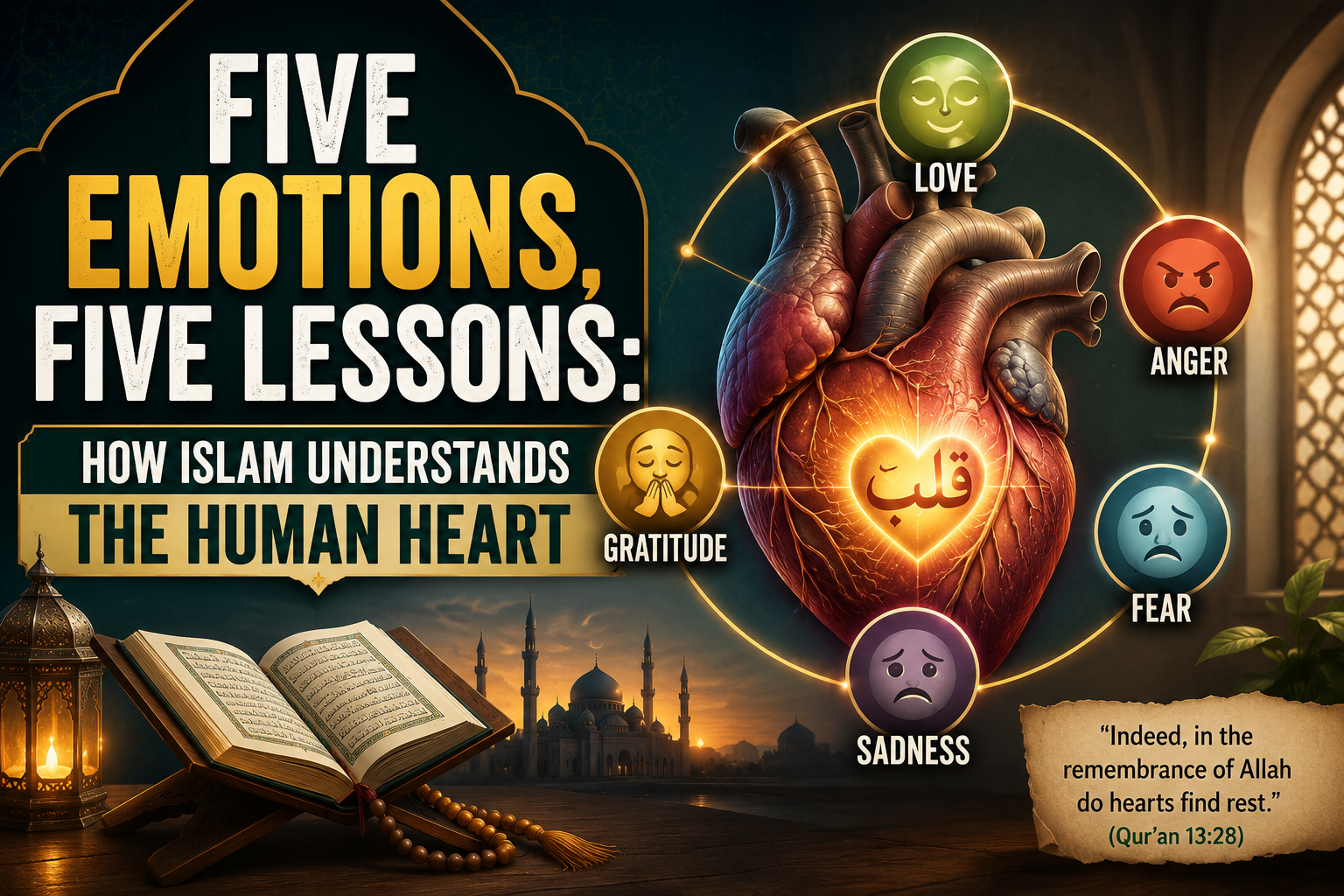
Five Emotions, Five Lessons: How Islam Understands the Human Heart
Emotion is often treated as something to be managed, suppressed, or overcome. Islam takes a different approach. The Qur'an speaks repeatedly to the heart (qalb), and the life of the Prophet Muhammad ﷺ shows a man who wept at loss, laughed with companions, feared consequence, hoped for mercy, and loved openly. In this tradition, emotion is not a flaw to hide — it is a signal to be understood and a force to be directed wisely.
What follows is a look at five emotional states given some of the deepest treatment in the Qur'an and Hadith, along with the practical wisdom each one offers.
1. Patience (Sabr): Turning Hardship into Meaning
Sabr is frequently translated as "patience," but the Arabic carries something richer — a steadfast, active endurance rather than passive waiting. It is the emotional posture of holding one's ground while difficulty passes through, without collapsing into despair or lashing out in frustration.
The Qur'an ties this quality directly to divine companionship, assuring believers that Allah is with those who remain patient (Qur'an 2:153). Elsewhere, it offers one of its most quoted reassurances: that with hardship comes ease, stated twice in succession for emphasis (Qur'an 94:5–6).
The Prophet ﷺ reportedly described patience not as mere endurance but as something closer to illumination — a source of light for the one who practices it, as recorded by Imam Muslim.
Why it matters emotionally: Sabr reframes suffering as temporary and purposeful rather than random and meaningless. That single shift in framing — from "this is happening to me for no reason" to "this is a passage, and I am held through it" — is itself a recognized form of emotional regulation, echoed today in resilience research.
2. Gratitude (Shukr): The Emotion That Multiplies
In Islamic thought, gratitude is not a polite afterthought reserved for good news. It is presented as an active spiritual mechanism with real consequence. The Qur'an records a striking promise: gratitude leads to increase, while ingratitude invites a severe reckoning (Qur'an 14:7).
The Prophet ﷺ modeled this even in the most private moments of worship. His wife Aisha (RA) narrated — in a report recorded in both Sahih al-Bukhari and Sahih Muslim — that he would stand in prayer at night until his feet became swollen. When asked why he exerted himself so greatly given that he was already forgiven, he replied simply that he wished to be a grateful servant.
Why it matters emotionally: Shukr trains attention toward what is present rather than what is missing. This is not a passive feeling but a discipline — one that modern positive psychology studies under nearly the same name, gratitude practice, and links to measurable improvements in wellbeing.
3. Hope and Fear (Raja' and Khawf): The Balance That Prevents Despair
Islamic scholarship often describes hope and fear as a matched pair — two wings of a single bird. Too much of either, unbalanced by the other, throws the believer off course. Excessive fear breeds despair; excessive hope breeds complacency.
The Qur'an's clearest statement on this balance is addressed directly to those who feel they have wronged themselves beyond repair: they are told never to despair of Allah's mercy, since every sin can be forgiven (Qur'an 39:53). Yet the same scripture cautions against the opposite extreme — feeling entirely secure from accountability (Qur'an 7:99) — so that hope never slides into carelessness.
Why it matters emotionally: This teaching speaks to two of the most common emotional traps people fall into — hopelessness and false security — and offers a corrective for both within the same framework, rather than treating them as unrelated problems.
4. Love (Mahabbah): Directed, Not Denied
Islam does not treat love with suspicion; it treats it as something to be rightly ordered rather than eliminated. The Qur'an describes true believers as those whose love for Allah exceeds every other attachment in intensity and priority (Qur'an 2:165) — not a rejection of human love, but a hierarchy that keeps it grounded.
On love between people, one of the most quoted Hadith on the subject involves a man who asked the Prophet ﷺ about someone he loved deeply but had not yet matched in righteous deeds. The Prophet ﷺ answered that a person will be with those he loves — a narration recorded in both Sahih al-Bukhari and Sahih Muslim.
Why it matters emotionally: Rather than suppressing attachment, this teaching validates it while gently redirecting it. Love is not treated as dangerous; it is given a compass.
5. Anger (Ghadab): Strength Redefined
Few teachings reframe an emotion as sharply as this one. When asked who truly counts as strong, the Prophet ﷺ answered that real strength is not found in overpowering others physically, but in controlling oneself in the moment of anger (Sahih al-Bukhari 6114).
On a separate occasion, a man repeatedly asked the Prophet ﷺ for advice, and each time received the same brief instruction in return: do not become angry (Sahih al-Bukhari 6116).
Why it matters emotionally: Anger is never denied or dismissed as illegitimate. Instead, the definition of strength itself is relocated — from dominance over others to mastery over oneself, which is arguably the harder and more valuable skill.